
The DOs and DON'Ts of Secure Coding.
Secure coding advice usually arrives as principles. This arrives as code: the do and the don't side by side, for Python, Java and JavaScript, pulled from Payatu's Secure Code Wiki.
AppSec
Secure Code Review
Pages:
81
Format:
PDF
Level:
Beginner to Intermediate
Updated:
Sep 2026

Key Takeaways
- Secure coding practices for the top programming languages by IEEE Spectrum ranking, worked in depth for Python, Java and JavaScript.
- Each practice written as a pair, the vulnerable pattern and the corrected one, so a reviewer can match it against real code.
- The reasoning behind each rule, so the practice transfers to languages the ebook does not cover directly.
- Compiled from the Secure Code Wiki, the same practices Payatu's consultants apply during secure code review engagements.
What's inside
Most secure coding guidance stops at the principle: validate input, do not trust the client, avoid the dangerous function. Developers already know the principles. What is missing at review time is the specific pattern, in the specific language, next to the correct version of it.
This ebook comes out of Payatu's Secure Code Wiki, a portal of secure coding practices contributed by our consultants alongside practices gathered from public sources. It covers the languages most code is written in, and shows each practice as code rather than as advice.
What the 81 pages cover
01
Introduction: why secure code practices
p. 5
What secure coding is for, and where it sits against the rest of the pipeline.
02
What the Secure Code Wiki is
p. 6
The portal the practices come from, and how it is maintained.
03
The authors and contributors
p. 8
The consultants who contributed the practices.
04
Top programming languages
p. 12
How the ranking is built, and which languages the ebook works through.
05
Best coding practices of the top languages
p. 13
Python, Java and JavaScript, practice by practice, with the do and the don't.
06
Summary
p. 79
What to apply first, and where to keep reading.
Look inside
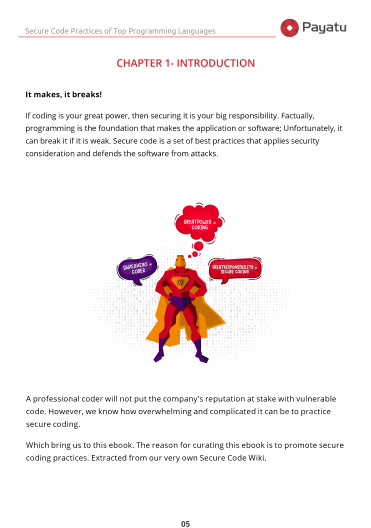
A sample spread — the level of detail in every chapter.
Written by Payatu's application security consultants


Put the practices next to the pull request
The full 81-page PDF, with every practice shown as code for Python, Java and JavaScript, written to sit open during code review.