
All You Need to Know About the ISA/IEC 62443 Standard.
62443 is a series of documents across 4 parts, and most people meet it as a compliance demand rather than a structure. This guide gives you the map: what each part covers, which lifecycle you are in, and which requirements land on your role.
OT & ICS
Standards
Pages:
36
Format:
PDF
Level:
Intermediate
Updated:
Oct 2026

Key Takeaways
- The structure of the series shown as a hierarchy rather than a list, with the derivation between parts 1-1, 2-1, 2-3, 2-4, 3-2, 3-3, 4-1 and 4-2.
- Which of the 4 roles you hold: asset owner, system integrator or service provider, operator, or product supplier, and what the standard makes each responsible for.
- The 2 lifecycle views: the product development lifecycle, and the automation solution lifecycle across integration and operation and maintenance.
- The foundational requirements and 4 security levels, with the SR and RE tables showing exactly what SL1 through SL4 demand of each.
What's inside
OT teams usually meet ISA/IEC 62443 the same way: a customer or a regulator names it, and someone has to work out which of its documents actually apply. The series is large, and reading it front to back is the slowest route to that answer.
This guide starts from the OT components you already run, SCADA, DCS, HMI, PLC, OPC, RTU and engineering stations, and places the standard over them. It covers the risk assessment flow from ZCR 5.1 through 5.13, the foundational requirements and security levels, and the product security lifecycle under 62443-4-1 and 4-2.
What the 36 pages cover
01
Introduction and the OT components in scope
p. 3
SCADA, DCS, HMI, PLC, OPC, RTU and engineering stations, in the standard's terms.
02
The ISA/IEC 62443 series of standards
p. 5
What the series sets out to do, and who it gives responsibility to.
03
The overall structure of the series
p. 9
The 4 parts, their derivation, and how to find the document that applies to you.
04
The 2 lifecycle views
p. 12
Product development against automation solution, and where your work sits.
05
Risk assessment under 62443
p. 13
The ZCR 5.1 to 5.13 flow, from threat identification to residual risk and sign-off.
06
Foundational requirements and security levels
p. 19
The FRs, the SRs and REs beneath them, and what each security level requires.
07
Product security lifecycle, 62443-4-1 and 4-2
p. 24
What a product supplier has to build, document and maintain.
Look inside
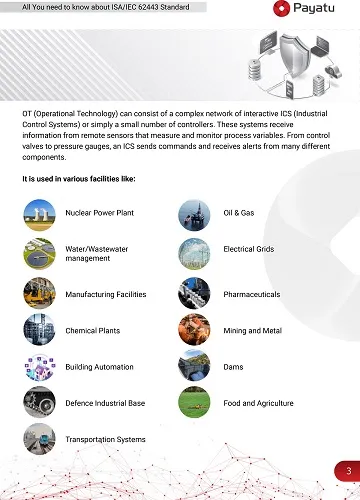
A sample spread — the level of detail in every chapter.
Written by Payatu's OT security practice



Keep the map beside the standard
The full 36-page PDF, with the series structure, the lifecycle views, the risk assessment flow and the security level tables in one reference.