













A weak API can harm a strong app

A low-risk flaw in one component plus an over-trusted connection to another adds up to a critical path.

We map how a mobile app leads to your API, how an API exposes your cloud, and how one weak link reaches everything.
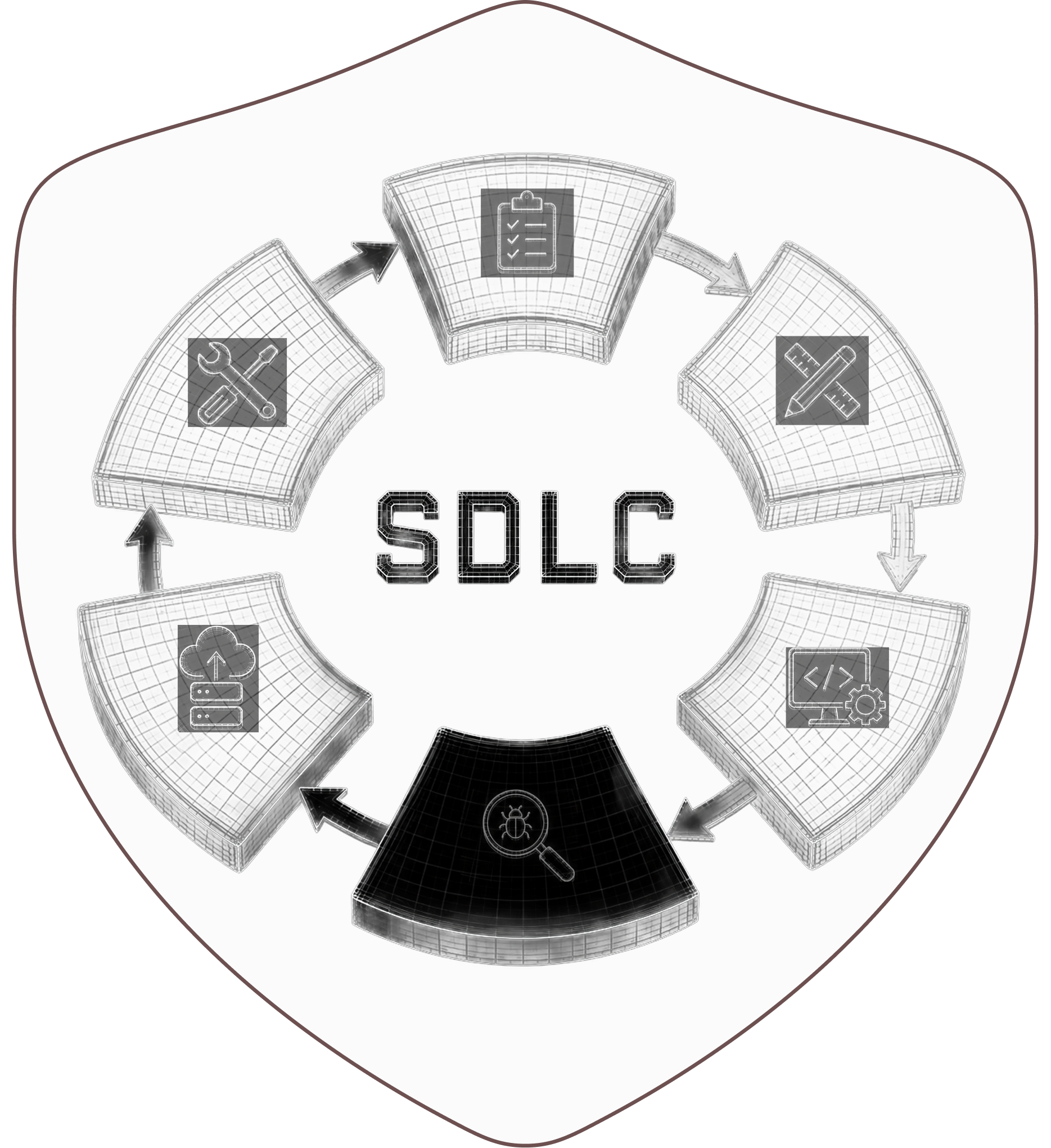
Circular flow diagram illustrating the Software Development Life Cycle (SDLC) with six sections: a checklist, pencil and ruler, computer with code and gear, magnifying glass with bug, cloud data upload icon, and tools (wrench and screwdriver), connected by arrows in a loop.Green square with white check mark icon next to the text 'Risk Assessment' in green on a dark background.Green checkmark icon next to the text 'Incident Response and Planning' in green font on a dark green background.Green checkmark icon next to the text 'Threat Modeling' in green on a dark background.Green square icon with a white checkmark next to the text 'CSPM' in green on a dark background.Green checkmark icon next to the text 'Security Testing' in green on a dark background.Green checkmark icon next to the text 'Static Analysis' in green font on a dark background.
Faint curved orange-red light streak on a dark black background with small scattered light dots.

The question that matters

Each finding looks low-risk on its own. But chained across your product, where does that path actually end?
WHY MOST PRODUCT TESTING FALLS SHORT

The dangerous flaws live in the trust between components

Strong authentication on your app means little if the API behind it trusts any request. Real attacks chain a small weakness here to an over-trusted connection there.

Testing components in isolation never sees those chains. We test the trust relationships, not just the parts.
Most Vendors
Separate testing per component
No integration or cross-component analysis
Individual vulnerabilities without context
Inconsistent security across components
Testing isolated from business priorities
Fragmented findings from different teams
Payatu
AI-native and research-led: one unified assessment across your whole product
Attack-path modelling across components
Integration and trust-relationship testing
A consistent security baseline, everywhere
Focused on your crown-jewel data and critical functions
One consolidated remediation roadmap
What we test on them

What we assess, across your whole product.

We test every component and the connections between them, the way an attacker sees your product.
Mobile apps
Web dashboards
APIs & microservices
Cloud backends
IoT devices
Third-party integrations
Data flows
Trust boundaries
Mobile apps
Web dashboards
APIs & microservices
Cloud backends
IoT devices
Third-party integrations
Data flows
Trust boundaries
Gradient background with smooth transition from dark blue on the lower left to deep red on the lower right, blending into black at the top.
The components
Mobile & web apps
APIs & backends
Cloud infrastructure
IoT devices & firmware
Dark background with a bright orange and yellow glowing light streak on the right side, fading into blackness.
The connections
Integration & trust boundaries
Data flows across components
Third-party & SDK risk
API authorization & abuse
The business
Crown-jewel data & functions
Attack paths across the stack
A consistent security baseline
Unified, prioritised remediation

The components

Mobile & web apps
APIs & backends
Cloud infrastructure
IoT devices & firmware
Gradient background with smooth transition from dark blue on the lower left to deep red on the lower right, blending into black at the top.
The components

The connections

Integration & trust boundaries
Data flows across components
Third-party & SDK risk
API authorization & abuse
Dark background with a bright orange and yellow glowing light streak on the right side, fading into blackness.
The connections

The business

Crown-jewel data & functions
Attack paths across the stack
A consistent security baseline
Unified, prioritised remediation
The business
Process

How it works

Simple, step by step, from first look to a product that stays secure.

Map the product

We learn your architecture, your critical functions, and how data flows between components.
01

Threat model it

We model how an attacker could chain weaknesses across your whole product.
02

Trace the attack paths

We show how a small flaw in one component opens a path to your crown-jewel data.
04

Test every component

Mobile, web, APIs, cloud, and IoT, tested individually and at the points where they connect.
03

One roadmap

Consolidated findings ranked by business impact, not separate reports to reconcile.
05

Keep it secure

Retesting and secure-design guidance as your product adds features and components.
06
Process

How it works

Simple, step by step, from first look to a product that stays secure.

Map the product

We learn your architecture, your critical functions, and how data flows between components.
01

Threat model it

We model how an attacker could chain weaknesses across your whole product.
02

Test every component

Mobile, web, APIs, cloud, and IoT, tested individually and at the points where they connect.
03

Trace the attack paths

We show how a small flaw in one component opens a path to your crown-jewel data.
04

One roadmap

Consolidated findings ranked by business impact, not separate reports to reconcile.
05

Keep it secure

Retesting and secure-design guidance as your product adds features and components.
06
Process
How it works
Simple, step by step, from first look to a product that stays secure.

Map the product

We learn your architecture, your critical functions, and how data flows between components.
01

Threat model it

We model how an attacker could chain weaknesses across your whole product.
02

Test every component

Mobile, web, APIs, cloud, and IoT, tested individually and at the points where they connect.
03

Trace the attack paths

We show how a small flaw in one component opens a path to your crown-jewel data.
04

One roadmap

Consolidated findings ranked by business impact, not separate reports to reconcile.
05

Keep it secure

Retesting and secure-design guidance as your product adds features and components.
06
Testimonials

What product teams say about working with us

Small white square with the top left corner cut out, creating a diagonal edge.
neoeyed logo in blue lowercase letters.
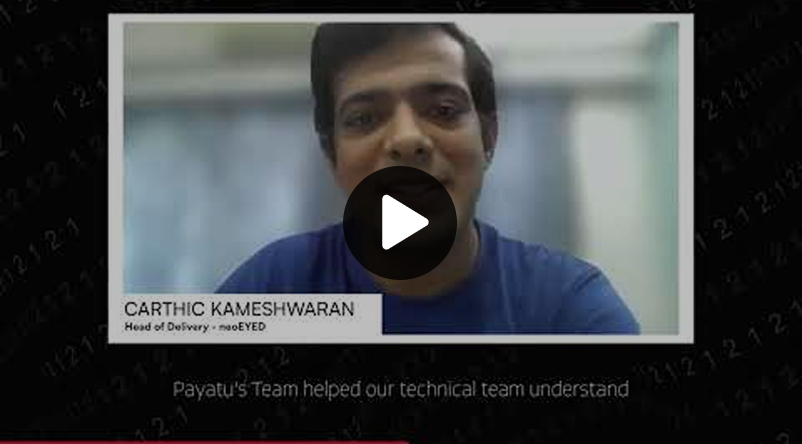
Video thumbnail showing a man named Carthic Kameshwaran, Head of Delivery at moEYED, speaking directly to the camera in a blue shirt.

Carthic Kameshwaran

Head of Delivery - neoEYED

Small white square with the top left corner cut out, creating a diagonal edge.
Stylized logo spelling the word 'nkash' with a geometric shape resembling an 'E' at the start in a gradient of blue shades.
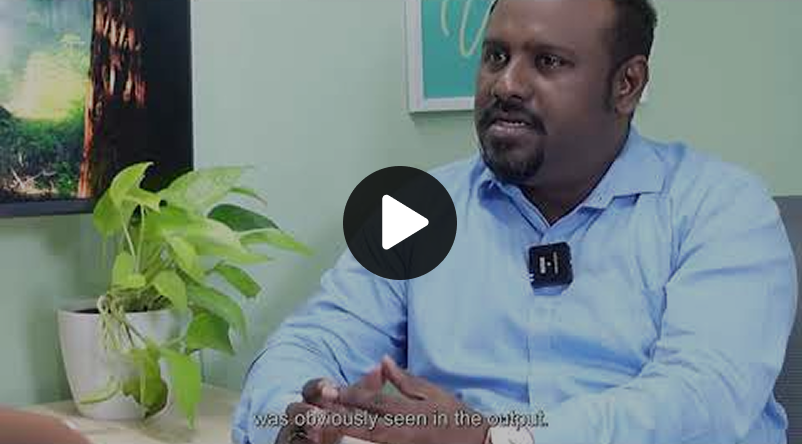
Man in a light blue shirt speaking indoors with a potted plant and framed picture on a green wall behind him.

Arockiaraj Martin

CISO- Enkash

Small white square with the top left corner cut out, creating a diagonal edge.
Logo featuring a stylized purple circle with an inner dot next to the text 'Butn' in purple font on a black background.
Payatu's focus on in-depth defence, quality, and proactive approach to all their services were precisely what our fast-growing publicly listed company needed.
Payatu's Services have helped us in ensuring that not only do we exceed strict compliance standards, but also ensure that security is not just a tick box exercise in our organisation. We have been able to make security an integral part of...


Simran Gambhir

Chief Information Officer - Butn, Sydney

Small white square with the top left corner cut out, creating a diagonal edge.
CheckRed Security company logo with a stylized red cloud and checkmark icon next to the black and red text.
Payatu delivered a 360-degree penetration testing exercise across our web applications and internal network. Their structured, methodical approach and deep technical understanding were evident throughout the engagement. They didn’t just give us a list of vulnerabilities, they provided actionable insights that helped to improve our security posture. The engagement was constructive.

Sushil Vanve

Director of Engineering - CheckRed

WHY PAYATU

Why product companies pick us

Most vendors test your product one component at a time. We test the whole ecosystem, and the attack paths that cross between components.
OSCP, OSCE, OSWE, eMAPT & AWS Security Specialty
Certin logo with stylized text and a graphic element resembling a circuit or connection symbol.
ISO 17025 accredited CERT-In empanelled
Founders of Nullcon &
hardwear.io
Icon of a gray document with three horizontal lines and a red dot on the left side, all inside a white circular background.
Research-informed across modern architectures
Gray circular radar screen with four crosshair lines, a small gray dot near the upper right, and a larger red dot near the lower left inside a white circular background.
Attack-path modelling across your product
Minimalist abstract design with light gray geometric shapes and lines connected by nodes and a single red circle inside a white circular background.
Mobile, web, API, cloud & IoT specialists in one team
Circle with a gradient of red shades, transitioning from dark red at the top to bright red at the bottom.Solid red symmetrical shape with pointed top and bottom edges, resembling an elongated lens or a leaf.
White text on a black background reading 'Secure products. Build customer trust.'
Icon of a gear with a circular arrow inside and a magnifying glass highlighting a red dot, above the text 'Secure Product Expertise'.
A white square target icon with a red dot in the center above the text 'End-to-End Protection' on a black background.
What you get

The whole story, and a product that stays secure.

Attack-path analysis

How an attacker moves across your product to reach your most valuable data.

Findings with business context

Each issue ranked by impact on revenue, data, and trust, not just a CVSS score.
Close-up of a laptop keyboard with code reflected on the screen, showing programming text with a hand nearby, illuminated by warm orange and purple lighting.

One threat model

Your whole product ecosystem in a single, clear picture.

One remediation roadmap

Consolidated and prioritised, organised by component for your engineers.
FAQ

Questions Web Application teams ask us

What is Web Security Testing?
Web Security Testing identifies vulnerabilities in web applications that attackers could exploit, helping organizations protect sensitive data and prevent security breaches.
What vulnerabilities are tested during a Web Security Assessment?
Web Security Testing identifies vulnerabilities in web applications that attackers could exploit, helping organizations protect sensitive data and prevent security breaches.
How is Web Security Testing different from a vulnerability scan?
Web Security Testing identifies vulnerabilities in web applications that attackers could exploit, helping organizations protect sensitive data and prevent security breaches.
When should we perform Web Security Testing?
Web Security Testing identifies vulnerabilities in web applications that attackers could exploit, helping organizations protect sensitive data and prevent security breaches.
What do we receive after the Web Security Assessment?
Web Security Testing identifies vulnerabilities in web applications that attackers could exploit, helping organizations protect sensitive data and prevent security breaches.
Can Web Security Testing identify business logic vulnerabilities?
Web Security Testing identifies vulnerabilities in web applications that attackers could exploit, helping organizations protect sensitive data and prevent security breaches.