
Security Risks in an EV Charging Station.
This is what came out of pentesting a charging station: an exposed console port, a readable firmware image, a cloneable RFID card, and OCPP carrying it all. Findings first, then what to do about them.
IoT & Hardware
Automotive & EV
Pages:
25
Format:
PDF
Level:
Intermediate
Updated:
Oct 2026

Key Takeaways
- The hardware findings from a real assessment: UART and console port access, JTAG, firmware extraction from memory, and configuration review.
- The user interface attack surface: RFID cloning, the display and touchscreen, and the companion mobile application.
- OCPP explained properly: how it works, what changed across versions, and the vulnerabilities that persist in deployed implementations.
- Which components matter inside a charging station and why, so you can scope an assessment before procurement rather than after deployment.
What's inside
Charger rollouts are moving faster than charger security. The unit is a computer with a payment interface, a radio link and a physical connection to a vehicle, deployed unattended in a public place, and often built on reference designs that were never assessed.
This ebook reports what a penetration test of a charging station actually surfaced: weak communication protocols, poor user authentication, and hardware access that should not have been reachable. Each finding is described with its impact, so operators and manufacturers can act on it rather than debate it.
What the 25 pages cover
01
Executive summary
p. 4
What the assessment found, and why it matters to operators and manufacturers
02
An introduction to EV chargers
p. 5
How a charging station is put together, in the terms an assessor needs.
03
Important components you should know
p. 6
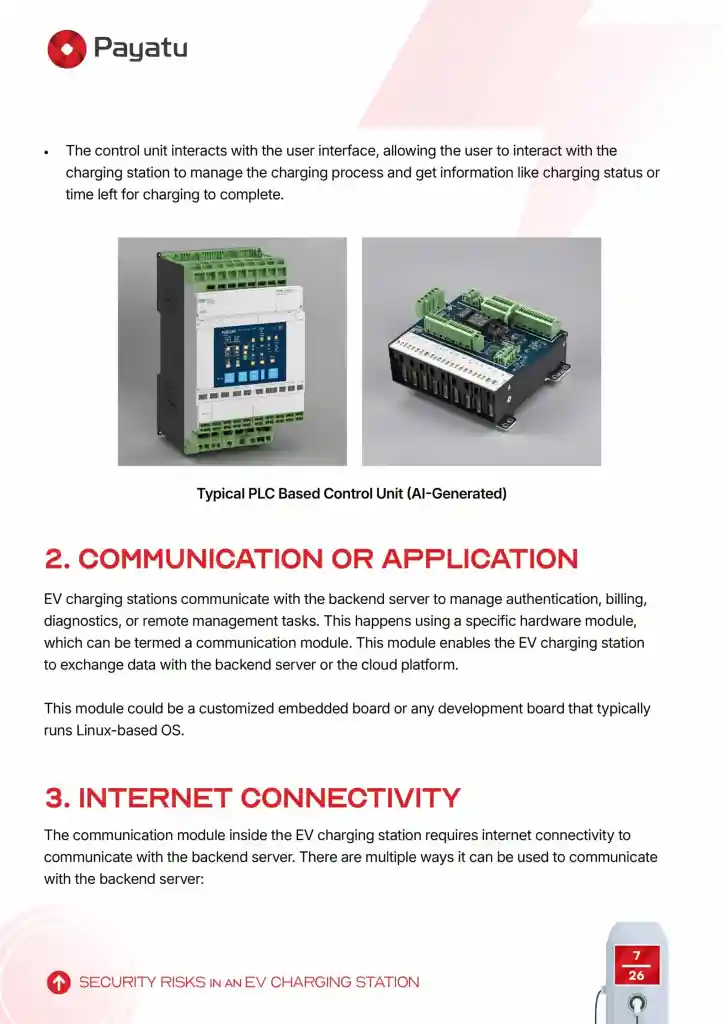
The control unit, communication module, user interface and what each exposes.
04
Hardware vulnerabilities in the control unit
p. 9
UART and console ports, JTAG access, firmware extraction, and configuration review.
05
Vulnerabilities in the user interface
p. 15
RFID, the display and touchscreen, and the mobile application.
06
Vulnerabilities in the communication protocol
p. 19
OCPP: how it works, its versions, and the flaws that survive in deployment.
07
Conclusion and references
p. 22
What to fix first, and where to read further.
Look inside
A sample spread — the level of detail in every chapter.
Written by Payatu's IoT security practice


Scope your charger assessment properly
The full 25-page PDF, with every finding, its impact, and the OCPP breakdown, written to be handed to the team building or operating the station.