
Automotive System Threat Modeling.
A threat model is only useful if every threat maps to an objective and every objective maps back. This whitepaper builds that matrix for an automotive and IoT system, from assets through to rationale.
IoT / Hardware
Automotive
Pages:
27
Format:
PDF
Level:
Advanced
Updated:
Sep 2026

Key Takeaways
- A worked Target of Evaluation: its type, its usage, its major security features and the full feature list, so the model sits on a real system rather than an abstraction.
- The asset breakdown most models skip: TSF data against user data, covering firmware, configuration, certificates and keys, network communication, voice records, event logs and device resources.
- Named threats you can reuse directly: T.IMPERSONATION, T.MITM, T.FIRMWARE_ABUSE, T.HARDWARE_ABUSE and T.REPUDIATION.
- The security objectives rationale matrix, mapping objectives against threats, security policies and assumptions so nothing is left unmapped.
What's inside
Automotive and IoT products carry the same core assets: firmware, keys, configuration, and the communication between them. What differs is who can reach those assets and for how long, because the device sits in the field, in the buyer's hands, for years.
This whitepaper follows Common Criteria structure without the overhead. It defines the target of evaluation, lists users, assets and threats, states security objectives for both the product and its operational environment, and closes with the rationale matrix that shows the mapping holds.
What the 27 pages cover
01
Executive summary
p. 5
What the model covers and who should be reading it.
02
Introduction and target of evaluation overview
p. 6
TOE type, usage, and the major security features in scope.
03
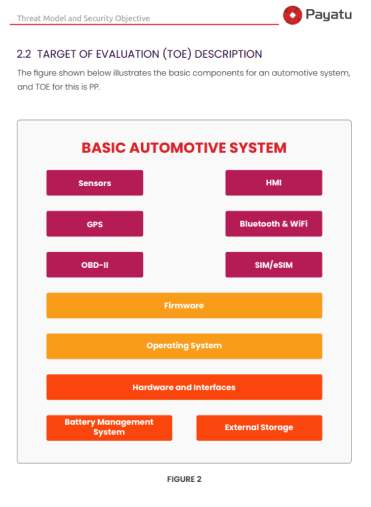
Target of evaluation description and features
p. 9
The system as modelled, feature by feature.
04
Security problem definition: users, assets and threats
p. 12
External entities, TSF and user data, and the named threat set.
05
Security objectives for the target of evaluation
p. 19
Firmware authenticity, hardware integrity, communication, audit and tamper objectives.
06
Objectives for the operational environment
20
Credentials management and trusted administration, stated as requirements.
07
Security objectives rationale
21
Objectives mapped against threats, policies and assumptions.
Look inside
A sample spread — the level of detail in every chapter.
Written by Payatu's IoT security research team



Reuse the model on your own product
The full 27-page PDF, with the asset list, the named threats, the objectives and the complete rationale matrix ready to adapt.