
API Security Essentials: The OWASP Top 10 API Playbook.
Most API guides stop at listing the ten risks. This one works each one from attack to fix: what the vulnerability actually is, how an attacker exploits it in practice, what it costs when it lands, and precisely how to close it.
Web & API
API Security
Pages:
60
Format:
PDF
Level:
Intermediate
Updated:
Oct 2026

Key Takeaways
- All 10 OWASP API Security Top 10 (2023) risks with a concrete attack scenario for each, not just a definition.
- Why BOLA and broken authentication cause most real API breaches, and the exact requests to send when testing for them.
- Remediation guidance written as pseudocode your engineering team can act on the same day.
- A test-case checklist to run against your own endpoints before the next release, plus the GraphQL and WebSocket cases most guides skip.
What's inside
The OWASP API Security Top 10 is the industry reference list of the most critical API risks. A list of names does not help you test. This playbook takes each risk and works it through what the vulnerability actually is, how an attacker exploits it in practice, what it costs when it lands, and precisely how to close it.
It is written the way our consultants work: attack first, evidence led, and specific enough to act on the same day you read it. Whether you are an engineer hardening an API before release or a security lead benchmarking your coverage, every chapter is a working reference rather than an overview.
What the 60 pages cover
01
Broken Object Level Authorization (BOLA)
p. 6
The single most exploited API flaw: how object references leak data, and how to test for it.
02
Broken Authentication
p. 10
Token handling, session flaws, and the auth mistakes that hand over accounts.
03
Broken Object Property Level Authorization
p. 16
Mass assignment and excessive data exposure, with real request and response examples.
04
Unrestricted Resource Consumption
p. 20
Rate limit and quota failures that turn into denial of service and runaway cloud bills.
05
Broken Function Level Authorization
p. 24
Privilege escalation through unprotected admin and role-based endpoints.
06
5 more risks, SSRF through unsafe consumption of APIs
p. 29
Server-side request forgery, security misconfiguration, improper inventory management and shadow APIs.
07
Extra mile: GraphQL and WebSocket testing
p. 50
Introspection abuse, batching attacks, and the plaintext WebSocket connections that survive review.
Look inside
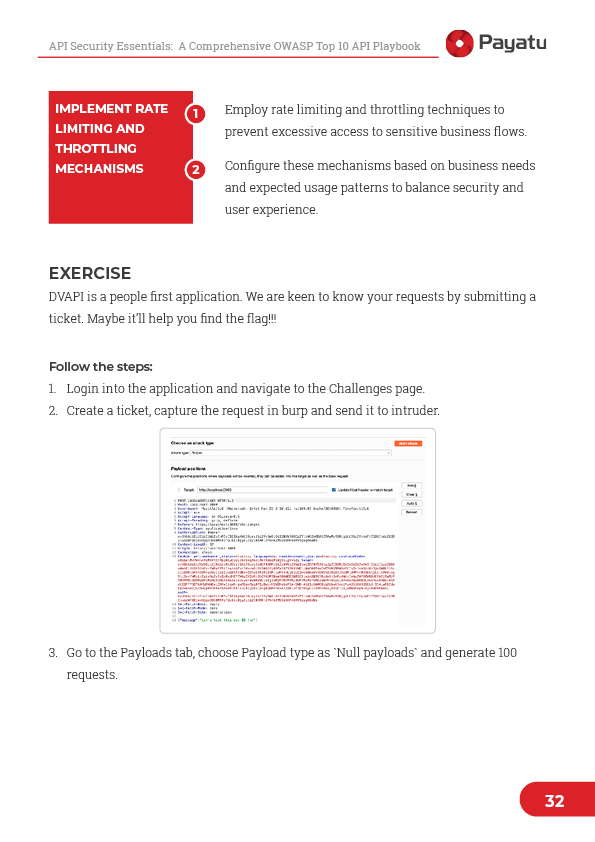
A sample spread — the level of detail in every chapter.
Written by Payatu's API testing team



Keep the playbook open while you test
The full 60-page PDF, with all 10 risks worked at the same depth, the sample spread, and the pre-release test-case checklist.