
How Is a Red Team Exercise Scoped and Priced in India? Cost, Timeline and Payatu's Approach




Key Takeaways
A red team tests whether an attacker can reach what matters, and whether you would notice.
Most red teams in India are scoped by objective: a list of targets to reach.
Rules of engagement move the price as much as the objectives do.
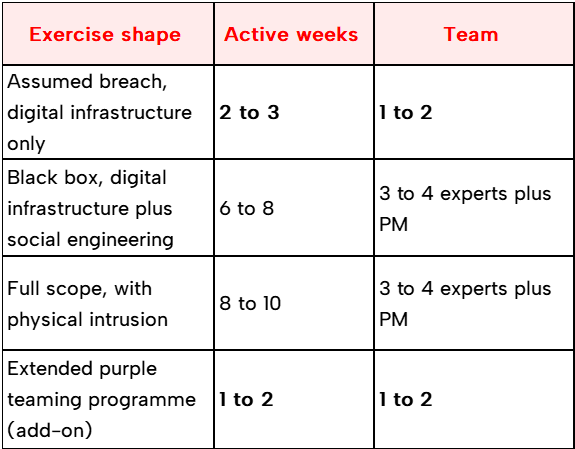
Digital infrastructure plus social engineering runs 6 to 8 weeks; one physical site makes (every location adds one week of time).
A typical team is 3 to 4 red team experts and a project manager.
Price follows the experts’ time and experience, plus attack infrastructure and reporting.
A certified red team in India costs ₹25 to ₹30 lakh.
A 8 to 10 lakh “red team” quote is usually a relabelled pentest.
SEBI requires half-yearly red teaming for exchanges, depositories and large intermediaries.
Payatu scopes from your intent and measures the exercise by its result.
A red team exercise in India is scoped against a short list of objectives an attacker would pursue, bounded by rules of engagement, and priced on the weeks of expert time the work needs. A typical exercise covering digital infrastructure and social engineering runs six to eight weeks with three to four red team experts, and eight to ten weeks with physical intrusion. Payatu scopes one step earlier: it first establishes why you want the exercise and what result you need, then designs the testing around that. At Payatu, the cost depends on the objective, the scope and the weeks of expert time the exercise needs.
This blog first explains how red teaming is generally scoped and priced in India, then how Payatu does it. For routine testing, check --> https://payatu.ai/blog/what-drives-the-price-and-duration-of-a-vapt-in-india
How red teaming is scoped and priced in India
What is a red team exercise?
A red team exercise is a simulated attack by security experts who behave like a real adversary. A penetration test asks what is exploitable on a defined set of systems. A red team asks whether an attacker can reach what you cannot afford to lose, and whether you would detect them. It tests technology, people, process and sometimes physical security together.
How is a red team exercise scoped?
It is scoped by objective, not by asset count. The buyer and the vendor agree in writing what the team should try to achieve, for example:
- Reach Domain Administrator.
- Exfiltrate a sample of customer records without the SOC raising a timely alert.
- Get a device onto the internal network from inside an office.
The exercise is measured against whether each objective was achieved. The path is left open, so a vendor needs little more than the entity name and the crown jewels to begin. The fewer constraints on the path, the more realistic the test and the more expert time it takes.
What do the rules of engagement decide?
They decide how the team is allowed to reach the objectives, and they move the price as much as the objectives do.

Record these in the scope document before the exercise begins. Changing them midway adds both time and cost.
How long does a red team exercise take?
Plan for three clocks, not one.

Who runs a red team exercise?
A typical Indian engagement fields three to four red team experts plus a project manager. The team is built from specialists, because no one person is equally good at reconnaissance, identity attacks, evasion and physical intrusion. Buyers increasingly name the certifications they expect in the RFP: OSCP, OSCE, OSEP, CAPE, CETP ,CRTP , CARTP and CRTE among them. Certified experts are scarce, which affects both price and start date.
How is a red team exercise priced by vendors?
Vendors price a red team exercise on three things: the size of the client organisation, the end goals of the exercise, and the test cases defined in the scope. A larger organisation has more people, locations and systems to cover. Harder end goals and more test cases take longer. That effort is then converted into days of expert time, which is what the quote is built on.
8 to 10 lakh is a common quote for a “red team” in India. Divide that by any credible expert rate and you get one or two people for two to three weeks. That is an external penetration test wearing the label. It can be the right purchase, but it is not the same work, and the gap between the two quotes is not negotiation room.
What should a red team RFP contain?
Five sections, so that every vendor quotes the same work.
- Objectives. Three to five, written as outcomes.
- Rules of engagement. Layers, starting posture, exclusions, detection measurement.
- Timeline, planned backwards from the date the report is due.
- Evidence format. Proof for every claim, an objective-by-objective scorecard, a detection timeline, a board narrative and a technical annex.
- Vendor qualification. The certifications of the red team experts who will run the exercise, a redacted sample report, a detection scorecard from a past engagement, and CERT-In empanelment with its validity date.
Is red teaming mandatory in India?
Only for some SEBI-regulated entities.
- SEBI: half-yearly red teaming is required from Market Infrastructure Institutions (MIIs), which are stock exchanges, clearing corporations and depositories, and from Qualified Regulated Entities (Qualified REs), which are the larger brokers, asset managers and other intermediaries above SEBI’s size thresholds - https://nsearchives.nseindia.com/content/circulars/INSP63502.pdf
- RBI: Optional for banks. The 2026 Direction makes vulnerability assessment and penetration testing mandatory and says a bank “may” conduct red teaming -> https://www.rbi.org.in/scripts/NotificationUser.aspx?Id=13643
- CERT-In: the 2025 audit guidelines recognise red team assessment as an audit --type, not an obligation -> https://cert-in.org.in/s2cMainServlet?pageid=GUIDLNVIEW02&refcode=CISG-2025-02
How Payatu scopes and prices a red team exercise
How is Payatu’s approach different?
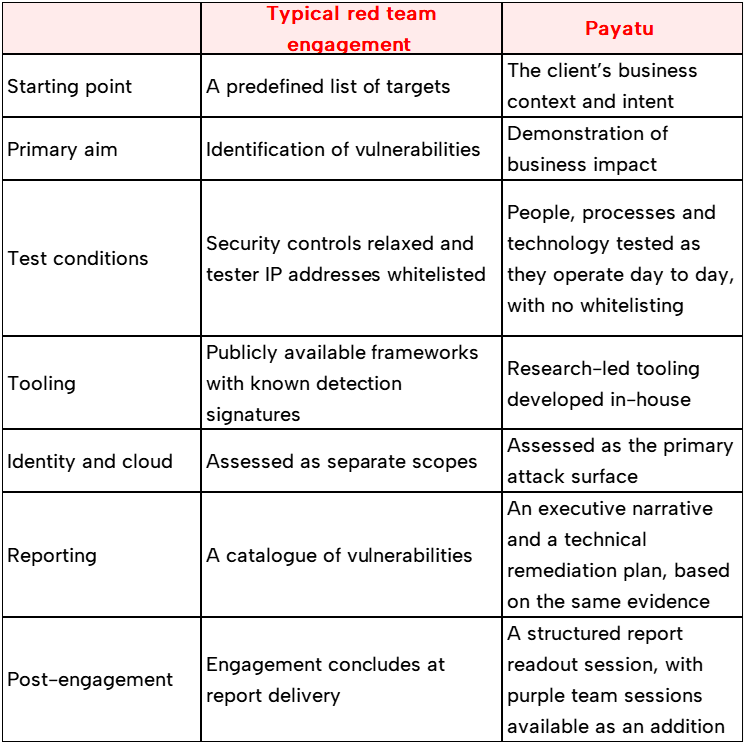
Payatu's approach is objective-driven. Each engagement begins with the client's business context and intent, tests the client's people, processes and technology as they operate day to day, and concludes with a structured report readout session. Purple team sessions, in which Payatu's red team experts work alongside the client's defenders, are available as an addition.
How does Payatu scope a red team exercise?
Payatu starts with the client’s point of view and intent, before any objective is written. Every engagement is built to answer one question: can a sophisticated adversary achieve their objectives against your defences as they actually operate?
The scoping call asks three questions :
- Why now? A regulator's deadline, a board question, an acquisition, an incident, or doubt about the SOC.
- What are your crown jewels? The data, system or process whose loss you could not absorb.
- What would you call a successful red team exercise? The decision, fix or evidence you need at the end.
Payatu then agrees the business objectives with you and tests against your live controls, with no whitelisting and no tuning down.
On a recent call, a client's head of IT and security put his intent in one line: understand the current posture from the attacker's perspective, so you know how they would get in and how far they would get. That sentence became the brief.
How does the client’s intent shape the testing?
The intent decides what Payatu tests and what it hands back. Objectives are derived from it, not picked from a standard list.

What results has this produced?
Two Payatu exercises show what a result looks like.
- The Great Breach: the rules were two lines, no denial of service and no zero-days. The headline was not that the team got in. Of 100 attacker actions, the SOC detected 9, and none in time to stop the chain.
- The Money Heist: a financial services firm was breached using a forged employee ID, created from a photo an employee had posted on social media. No test limited to digital infrastructure would have found it.
Who is on a Payatu red team?
Three to four red team experts and a dedicated project manager, drawn from a bench of 25 to 30 consultants. They hold OSCP, OSCE, OSEP, CRTO, CRTL, CRTP, CRTE, CAPE and CETP among other certifications, and are active researchers who speak and train at DEF CON, Black Hat, Nullcon and Hardwear.io. Payatu’s red team works with tooling developed in-house. AI speeds up reconnaissance, OSINT and some code review; people place the pretext call, choose the attack path and run the physical intrusion.
What decides the cost of a Payatu red team exercise?
The cost depends on the shape of the exercise: how many layers are in scope, how many weeks of active testing it needs, and the size of the team. Payatu prices on expert time and shows the working in every proposal. The table shows the usual shapes.
How do you start?
Send Payatu the reason you are considering a red team, what you cannot afford to lose, and any rules of engagement. Payatu then sets up a call to understand your expectations. You will receive a scoped proposal built around the result you need, with the arithmetic shown. Ask for the red team sample report in the same message. Payatu is CERT-In empanelled, ISO/IEC 17025 accredited and winner of the DSCI Award 2025.


Questions Web Application teams ask us.
Keep Reading





We break browsers before someone else does
This is the default text value

