
Your Access Reviews Passed the Audit. Did They Remove Anything?




Almost every organisation that answers to an auditor runs access reviews: quarterly, sometimes half-yearly, and for sensitive systems perhaps monthly. SOX, ISO 27001, SOC 2 and most other frameworks treat periodic access review as a basic control. The evidence folder is full of signed spreadsheets, the auditor is satisfied, and the control is marked effective.
And yet the research keeps finding the same thing: access that should not exist, and that stays. Accounts left active after a person left, permissions never withdrawn after a project ended, rights that quietly accumulated as people changed roles.

These are exactly the findings a periodic review exists to catch. So if everyone reviews access so regularly, how does so much unwanted access survive?
Because there are two kinds of access review, and from the outside they look identical. One protects your organisation. The other protects your audit report.
What a formality looks like
A manager receives an email on Monday morning with a spreadsheet of about two hundred rows: usernames, entitlement codes nobody can read, Active Directory group names that mean nothing to a business user, and one column that says Approve or Revoke. The deadline is Friday, and there is a full week of real work ahead. So the manager selects the whole column, types Approve, signs, and returns it. Ten minutes, done.
Compliance is satisfied and the evidence is captured, but not one real decision was taken. The manager did not know that three of those people left the team eight months ago. He did not know that a contractor was given access to the financial reporting system “temporarily” two years back. And he did not know that one entitlement, buried in the middle of the sheet, lets an analyst create a vendor and also approve the payment to that same vendor. That last one is not an access problem. It is a fraud scenario.
[[Quote]]
It is rarely the reviewer’s fault
In our experience, reviews do not become hollow because people are careless. They become hollow because the process sets the reviewer up to fail.
- Too much data, too little context. With hundreds of rows and a few days, “approve all” is not negligence. It is survival.
- The wrong language. Access is shown in system terms, not business terms. A manager can tell you whether someone should be allowed to issue refunds, but cannot tell you what FIN_GL_ADJ_POST_02 means, and nobody should expect them to.
- The wrong reviewer. IT is asked to confirm business need and the business is asked to confirm technical rights, so neither can say no with confidence.
- Timing detached from reality. A review that runs on a fixed quarterly date will always miss the employee who changed teams the week after the last cycle and carried all the old rights into the new role.
These are design flaws, which makes them a leadership problem and not a training problem.
What a working review looks like
The difference is not frequency or paperwork. A working review is designed to make “no” easy and “yes” a genuine decision.
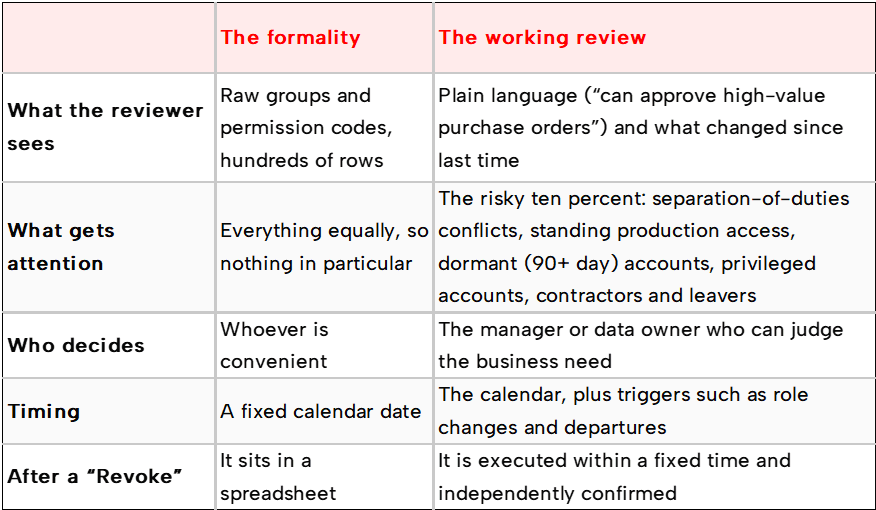
You do not need to sit inside a review to know which kind you have. Look at what came out of it. Take the last four cycles and ask: how much access was actually removed?
In any real organisation, where people join, leave, move teams and take temporary access all the time, the environment is never perfectly clean. A review that returns only approvals, cycle after cycle, is not evidence of a clean estate. It is evidence that the review cannot see the problem. (There is one fair exception: if joiner-mover-leaver processes remove access upstream, revocations at review time can legitimately be low. But then you should be able to show that evidence, not assume it.)
I still remember one review where a serious look uncovered a contractor whose account was terminated on paper but still live and working, many months after the project ended, holding access to systems nobody remembered granting. No firewall or SIEM alert caught it. It was caught because, for once, someone looked at the list with context and with the intention to see. A formality would have approved the same account for the fourteenth time.
Contractors and partners deserve particular attention. In Verizon’s 2026 Data Breach Investigations Report, third parties were involved in 48% of breaches, which the report describes as a 60% increase.
A scorecard for leadership
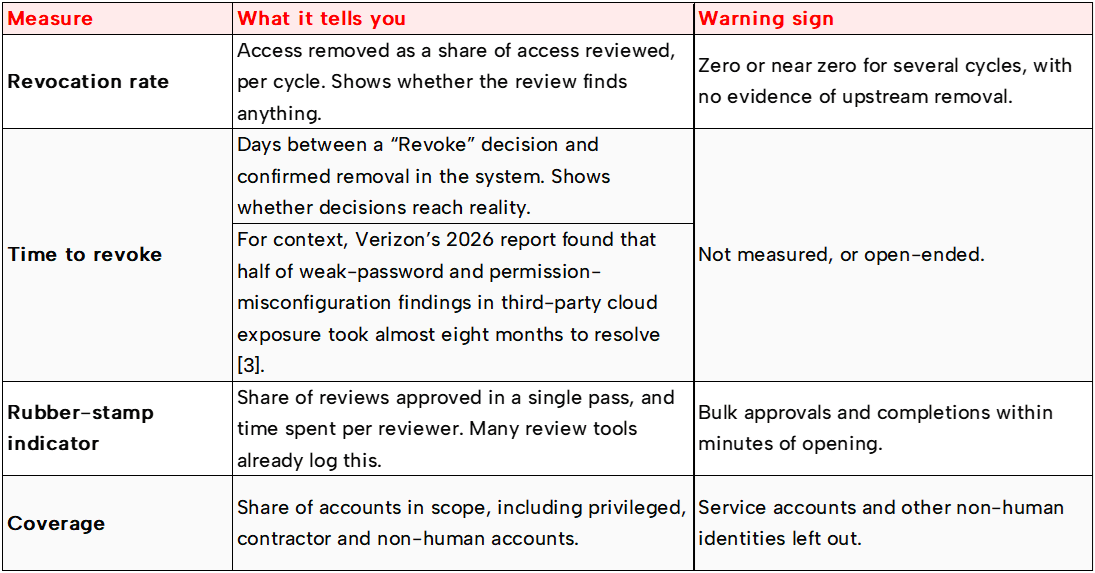
If you want to know whether your access review is a control, ask for these four measures each cycle.
The bottom line
Access review is one of the oldest controls we have, and one of the easiest to hollow out until only the shell is left. The danger is that the shell still passes the audit, and a control that looks healthy stops everyone from questioning it. Least privilege does not come from running a review. It comes from running a review that is allowed to change something.
[[Quote]]
Sources and notes
[1] CyberArk, 2026 Identity Security Landscape. Survey of 2,930 global cybersecurity leaders.
https://www.paloaltonetworks.com/idira/identity-security-landscape-report
[2] Veza, 2026 State of Identity & Access Report, released 11 December 2025. Analysis of millions of identities across large enterprises. https://veza.com/company/press-room/veza-identity-access-research-report-reveals-identity-permissions-sprawl-has-reached-critical-levels-amid-explosion-of-machine-and-ai-agent-identities-across-the-enterprise/
[3] Verizon, 2026 Data Breach Investigations Report, Executive Summary. More than 31,000 incidents and 22,000 confirmed breaches, October 2024 to November 2025.
https://www.verizon.com/business/resources/executivebriefs/2026-dbir-executive-summary.pdf


Keep Reading





We break browsers before someone else does
This is the default text value

