
How a Simple IDOR Led Me to Delete Any Account



.png)


Introduction
How did an IDOR (Insecure Direct Object Reference) Vulnerability lead me to delete anyone’s account? This is a tale about a particular application that had a ‘delete user’ feature which couldn’t validate the CSRF token and cookie header in the HTTP request. The application was not using any kind of UUIDs for referencing the objects in the account deletion request.
What is IDOR
According to OWASP, Insecure Direct Object References (IDOR) occur when an application provides direct access to objects based on user-supplied input. As a result of this vulnerability attackers can bypass authorization and access resources in the system directly, for example database records or files.
Insecure Direct Object References allow attackers to bypass authorization and access resources directly by modifying the value of a parameter used to directly point to an object. Such resources can be database entries belonging to other users, files in the system, and more.
This is caused by the fact that the application takes user supplied input and uses it to retrieve an object without performing sufficient authorization checks
So, I became a part of a new program. Upon visiting the scope URL,it turned out to be an ecommerce application that had two user roles.
- Seller
- User
The seller role had permission to invite new users. So I tried to test this feature as it looked intresting.
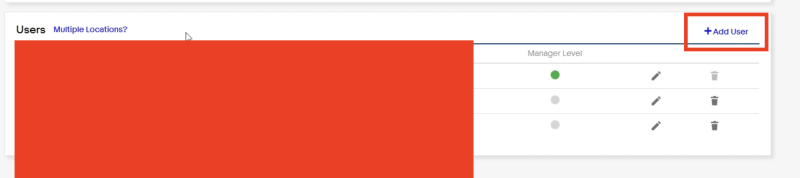
I quickly sent an invitation to my email id and checked the response in my Burp proxy. I saw that the send invitation response contained a numeric parameter named user_number
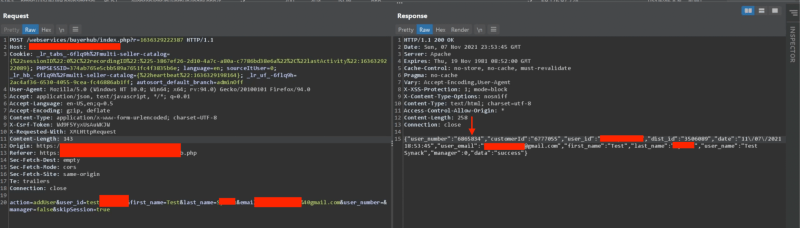
To check whether the userID was incremental or not, I sent another invitation and as suspected it was in the incremental order. So, if the previous ID was 6865834, then the next ID would be 6865835, 6865836 and so on.
The first thing that came to my mind was to test for IDOR on delete account feature. To do that, I quickly intercepted the delete user request and sent it to Burp Repeater.
Next thing, was to remove the cookie header completely and check whether it worked or not, and yes it was working. This meant any attacker could delete anyone’s account without being authenticated by the application.
But the problem was this particular request that had a X-Csrf-token header, which contained a random CSRF token in the request. Without that header, the response was ‘403 forbidden’.
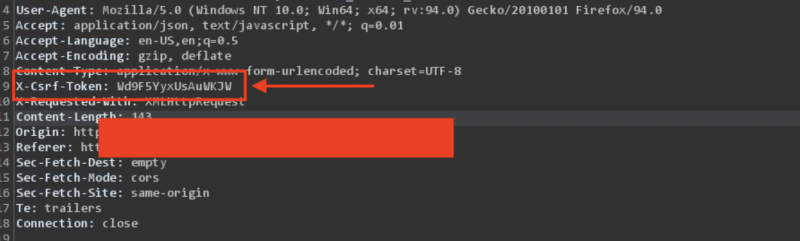
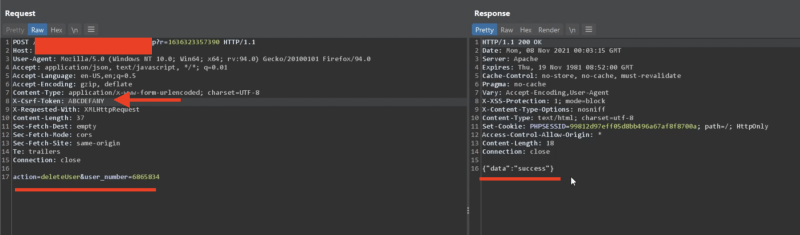
After a while I understood that there was no need to put an actual CSRF token. You could put any random string like ABCD in the header, so you could put like X-Csrf-Token: ABCD. and it would get accepted by the server.
The final request for the account deletion was
This issue was resolved by enforcing the validation on cookie header, CSRF token validation on the delete user endpoint and by using a random user ID.
Takeaway
- Always try to play with request headers
- Use GUIDs for referencing the objects.
- Always impose server side validation on CSRF tokens


Keep Reading
.png)




We break browsers before someone else does
This is the default text value

