
Foundations of Industrial, ICS, and Cyber-Physical Security



.png)


Key Takeaways
- OT is the hardware and software that monitors and controls physical processes - sensors, actuators, PLCs, HMIs, SCADA, DCS - split conceptually into the process and the controller.
- OT is the umbrella, ICS is its industrial subset, and CPS is the broadest category, covering smart grids, autonomous vehicles and medical systems.
- IIoT sits inside OT when it runs plant-floor sensors and actuators; consumer IoT does not.
- OT security inverts IT's priorities: availability, human safety and process reliability come before confidentiality.
- A breach in IT leaks data; a breach in OT means downtime costing crores, worker injury, environmental damage and compliance penalties.
- Legacy OT was never built for exposure - no encryption, weak authentication, no patching path - and IT/OT convergence has widened that gap.
- Stuxnet, TRITON, Industroyer, Colonial Pipeline and the 2025 Norwegian dam breach (opened by a weak default password) show these are real, targeted attacks, not theory.
What is OT Cybersecurity? Understanding the Foundations of Industrial, ICS, and Cyber-Physical Security
Welcome to the first part of Payatu’s comprehensive Masterclass on Operational Technology cybersecurity, designed to equip you with foundational knowledge.
Goal for This Blog
No lectures. No corporate pitch decks. In this opening blog, we will set the stage for your journey into the world of Operational Technology (OT) security. You’ll understand what Operational Technology (OT) actually is, how it’s different from traditional IT, and why it matters so much in the age of connected industries. We will also cut through the fog around OT, ICS (Industrial Control Systems), and CPS(cyber-physical systems), how they overlap and differ.
This blog is designed for both technical and non-technical readers — so we’ve included simplified analogies and real-world examples
[[BLOCKQUOTE]]
Let’s Paint a Picture
Picture a factory floor humming with precision. Motors spin, actuators twitch, sensors tick. A small controller (called a PLC) decides when a robotic arm should seal a box. If that controller is compromised, production could stop. Even worse, someone could tamper with the motion control logic and cause injury or damage. That’s why OT cybersecurity matters.

What is Operational Technology (OT)?
Operational Technology (OT) refers to the collection of hardware and software systems that interact with the physical environment to monitor, control, and automate physical devices, processes, and events across industries such as manufacturing, energy, utilities, transportation, and more. [1][7].
You’ve got sensors that sense, systems that monitor/decide, and components that act
Common OT components include:
- Sensors and actuators,
- Supervisory Control and Data Acquisition (SCADA),
- Distributed Control Systems (DCS),
- Programmable Logic Controllers (PLC),
- Human Machine Interfaces (HMI).
- Building Automation Systems
- Physical access and environmental monitoring systems
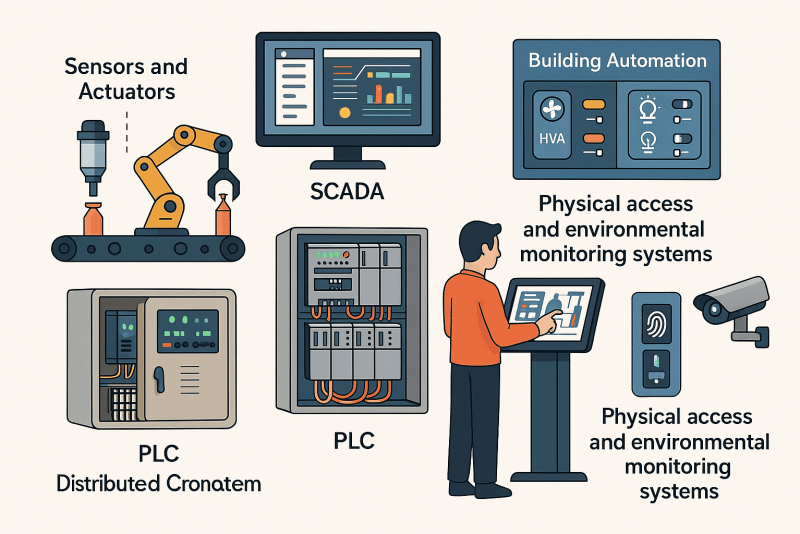
Each OT system can be broken down into two conceptual components:
- Process: The actual operation producing output (e.g., refining oil, packaging goods).
- Controller: The logic layer ensuring the process meets specifications (e.g., PLCs, DCS controllers).
In simple terms: If IT manages data, OT manages physical operations. Think of IT as the brain and OT as the hands and legs that actually move things in the real world.
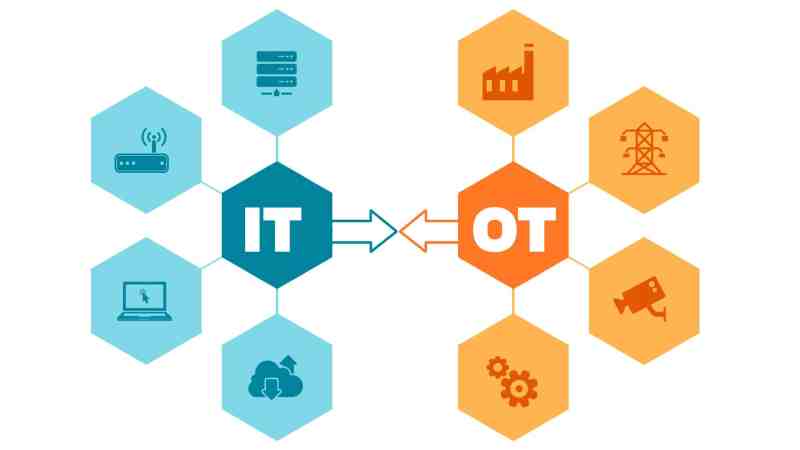
Unlike IT, which manages and stores data, OT systems trigger direct physical changes. —like stopping a conveyor belt or opening a valve. OT devices include both digital and analog components and often combine electrical, mechanical, hydraulic, or pneumatic control systems. This is the part that makes this field so unique and challenging.
OT, ICS, and Cyber-Physical Systems (CPS) — How Are They Related?
You might be wondering, “Wait, where do ICS and CPS fit in?” Let’s Simplify:-
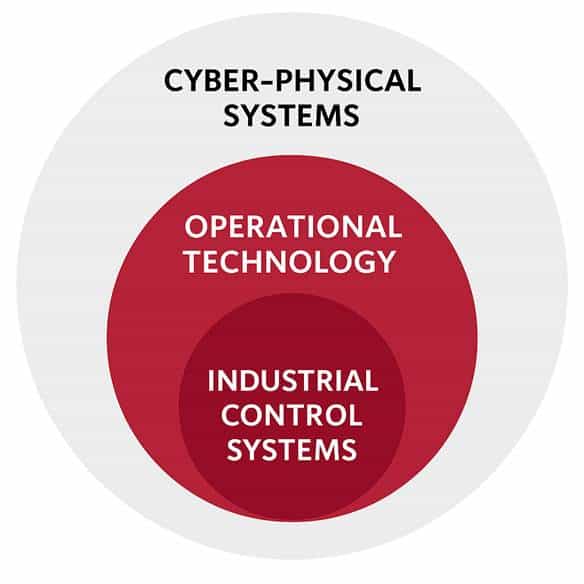
OT is the umbrella term for any hardware/software that interacts with or controls the physical world.
ICS is a subset of OT, commonly found in industrial contexts like manufacturing, oil & gas, and energy.
CPS (Cyber-Physical Systems) is a broader category that includes both OT and modern smart systems where software and physical processes are deeply integrated, such as smart grids, autonomous vehicles, and medical systems.
Let’s take a couple of relatable examples:
Food manufacturing plant: A temperature sensor continuously monitors heat levels in sterilization chambers. ensures that chambers remain within safe limits. A PLC (controller) automatically adjusts the heating to maintain precise sterilization. If this logic is altered, food safety is compromised.
- Water treatment facility: Chlorine dosing is monitored and controlled through sensors and valves. A cyberattack here could over-dose or under-dose, putting public health at risk.
Similarly, consider a familiar example: your home’s smart thermostat that adjusts your AC based on room temperature? That’s a basic cyber-physical system (CPS). Now, imagine hundreds of such interactions happening every second in a factory. That’s the kind of scale and complexity industrial OT systems manage daily. And even small disruptions can have significant consequences.
Is IoT Part of OT?
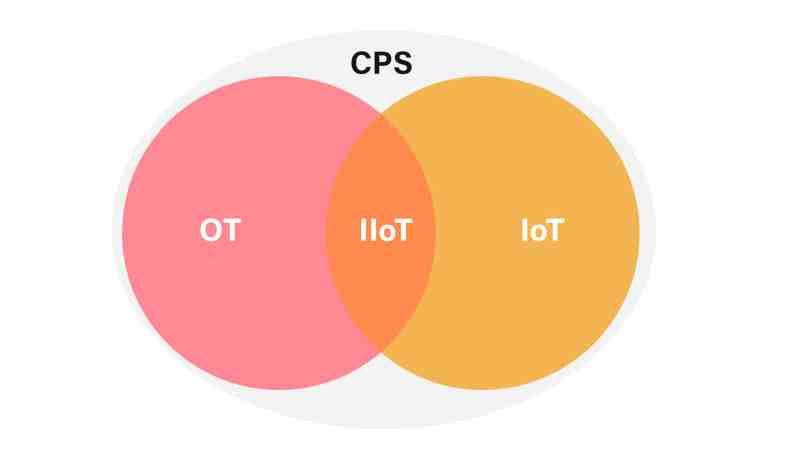
Ah, the classic debate whether the Internet of Things (IoT) belongs under the umbrella of OT [7].
Short answer? Sometimes yes — and sometimes no.
It depends on the context
- Industrial IoT (IIoT) is a subset of OT, especially when it connects sensors, controllers, and actuators on the factory floor. (e.g., sensors and actuators on a plant floor)
- Consumer IoT (like smart watches or Wi-Fi lightbulbs), however, does not qualify as OT, since it doesn’t operate critical physical processes in industrial or infrastructure environments. (e.g., smart watches, home bulbs)
What is OT Cybersecurity?
OT Cybersecurity Requires a Mindset Shift
In traditional IT environments, cybersecurity often means protecting data — emails, databases, and files. In OT, however, the stakes are different. Here, we’re protecting physical processes and real-world outcomes.
This shift in consequences requires a shift in mindset:
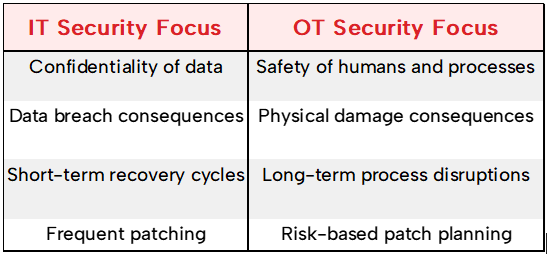
OT cybersecurity is the discipline focused on protecting industrial and cyber-physical systems from digital threats [1][2]. Unlike traditional IT security, which emphasizes confidentiality and integrity, OT security is primarily concerned with:
- Availability of operations
- Safety of humans and the environment
- Reliability of physical processes
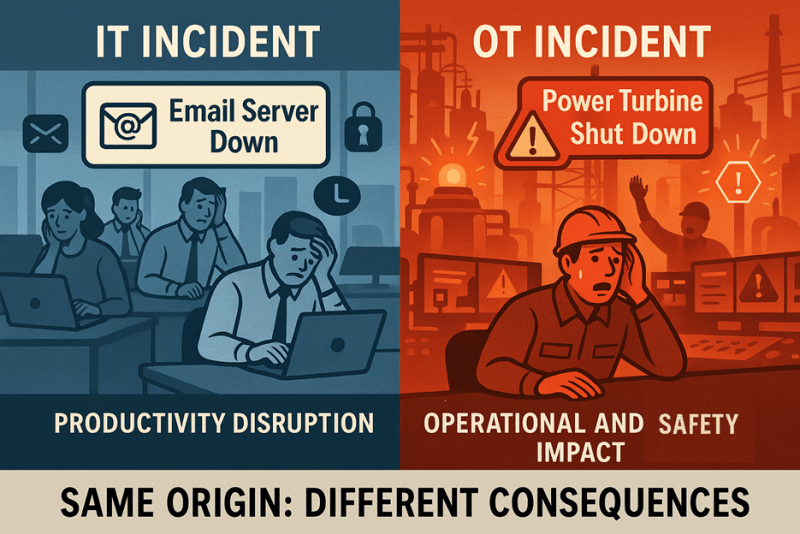
Think of it like this: In IT, a data breach might leak emails. In OT, a breach could shut down a power plant or cause a machine to malfunction, worker injuries, or even public safety incidents.
A successful cyberattack on an OT system can cause real-world physical damage, safety incidents, environmental hazards, and economic disruption.
Why Does OT Cybersecurity Matter —Big Time
Business & Safety Consequences
OT cyber incidents are not just digital disruptions — they have real-world implications:
- Production Downtime: A few hours offline can cost crores in lost output.
- Worker Safety: Compromised safety systems can put human lives at risk.
- Environmental Damage: Leaks, spills, and emissions can result from OT failures.
- Compliance Fines: Regulatory violations can trigger penalties and loss of license.
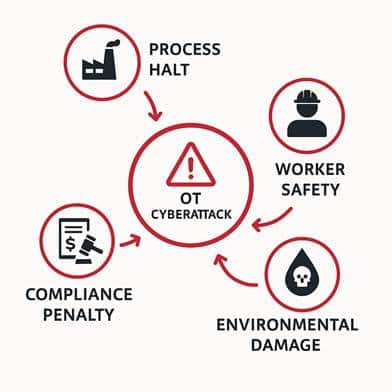
Whether it’s a power grid blackout, a signal failure in metro rail, or a chemical overdose in water treatment, OT breaches carry multi-dimensional consequences.
And with IT/OT convergence accelerating, the risks have multiplied. Many legacy OT systems weren’t designed for internet exposure—and often lack:
- Encryption
- Authentication
- Patching mechanisms
- Remote access controls
This has made OT environments prime targets for nation-state actors, ransomware gangs, and insider threats. Real-world attacks that shook the industry, such as Stuxnet [4], TRITON [5], Industroyer [6], and the Colonial Pipeline ransomware incident [3], have shown that OT systems are not only vulnerable but strategic attack surfaces. One of the most recent examples is the Norwegian Dam breach[8], where attackers remotely accessed a hydroelectric dam’s control system via exposed interfaces secured by only weak default passwords. They forced a water valve open for over four hours — a clear reminder of how simple lapses in OT access control can lead to serious consequences.
These are not hypothetical. They were real, targeted, and highly disruptive.
Protecting OT systems isn’t optional—it’s foundational to: –
- National security
- Critical infrastructure uptime
- Human safety
- Business continuity
Wrapping Up
This is just the beginning. From factory floors
to power grids
, OT runs the world we rely on every day. Learning how to secure it is essential — and you’re already on your way
.
Test Your Understanding – Quiz
Instructions: Read each question carefully.
Think you know OT fundamentals? Let’s have some fun — tap to explore! Choose the answer you believe is correct. Click “Show Answer” to check yourself.
Q1. What is the primary focus of OT systems?
A. Data confidentiality
B. Physical process automation and safety
C. Cloud scalability
D. Marketing analytic
Show Answer
B. Physical process automation and safety
Q2. Which of the following is NOT typically part of an OT system?
A. PLC
B. SCADA
C. CRM system
D. Sensors
Show Answer
C. CRM system
Q3. OT, ICS, and CPS — which is the broadest category?
A. CPS
B. ICS
C. OT
D. IoT
Show Answer
A. CPS
Q4. Why is availability a top priority in OT systems?
A. Because the internet is unreliable
B. To maintain continuous physical operations
C. To sync marketing emails
D. To avoid long login times
Show Answer
B. To maintain continuous physical operations
Q5. Which of these is key reason Legacy OT systems are difficult to secure?
A. They are open-source
B. They are designed without security in mind
C. They only use encrypted Wi-Fi
D. They are frequently patched
Show Answer
B. They are designed without security in mind
Q6. Which incident targeted physical centrifuges using malware?
A. Colonial Pipeline
B. SolarWinds
C. Stuxnet
D. Pegasus
Show Answer
C. Stuxnet
References
[2] International Society of Automation (ISA), “ISA/IEC 62443 Series of Standards”
[4] Symantec, “W32.Stuxnet Dossier,” Feb. 2011
[5] Dragos, “TRISIS: Analyzing Safety System Targeting Malware,” Dec. 2017
[6] ESET, “Industroyer: Biggest Threat to ICS Since Stuxnet,” Jun. 2017
[7] NIST, “Cyber-Physical Systems (CPS),” CPS Public Working Group
[8] Radiflow, One Weak Password, Full Process Control: Inside Norway’s 2025 Dam Cyberattack. July 2025
Coming Up Next
IT vs OT: Key Differences in Security, Design, and Risk
Now that you have understood what OT is, the next step is to see how it’s fundamentally different from IT in purpose, design, and risk. That’s where many security professionals struggle. Let’s make sure you’re not one of them.


Keep Reading
.png)



We break browsers before someone else does
This is the default text value

